



Production outage
Application Example: Error Analysis and Leak Detection in an Industrial Heating System Using DASYLab SPS Edition
Initial Situation and Problem:
In a production plant, severe malfunctions occurred in the connected heating system. As soon as a specific production area was switched on, the pressure in the heating system dropped steadily. The fatal result of this unresolved problem was ultimately the total failure of the heating system for the entire plant, leading to a complete production halt of 2 x 5 hours.
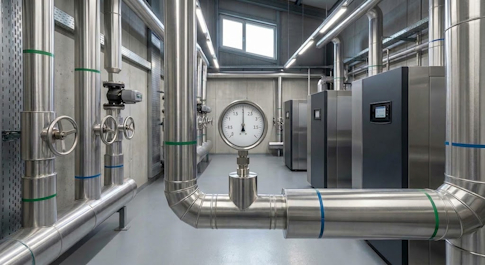
An internal inquiry as to whether the system autonomously compensates for the pressure drop through an automatic water refill was answered in the negative. A technician initially tried to isolate the problem by directly observing individual values live in the programmable logic controller (PLC). However, since the values were only viewed in real-time and not recorded historically, the dynamic behavior of the system could not be reliably tracked.
The Solution: Data Acquisition with the DASYLab SPS Edition
To make the process transparent and to log the actual behavior of the heating system, the technician decided to use the DASYLab SPS Edition.
The measurement configuration was carried out in two simple steps:
S7 Module: Connection to the controller to read out the system-specific process values.
Python Module: The module was configured to read the exact pressure value of the heating system every second and log it clearly in a table.
Diagnosis and Findings:
The continuous recording immediately provided a clear picture of the system's behavior. The normal pressure of the heating system was a constant 2 bar. As soon as the production line in question started up, the software documented a reproducible sequence:
The pressure dropped continuously from 2.0 bar down through 1.9 and 1.8 to 1.7 bar.
Subsequently, the pressure suddenly rose back to the target value of 2.0 bar within just one minute.
Since an automatic refill system had already been ruled out, these unequivocal data led to a surprising realization: the production staff had intervened manually.
The employees had noticed the pressure drop and, as a supposedly minor correction, quickly opened two valves by hand to bring the pressure back to 2 bar and keep production running. Because they considered this an insignificant routine action, the measure was not communicated.
As long as this manual "workaround" was carried out, the system ran. However, when the manual refilling was forgotten on one occasion, the pressure dropped so far that it led to the aforementioned, disastrous system standstill and hours of production loss.
Measure and Result:
With data-based proof of massive physical water loss, the maintenance team could take targeted action. The insulation of the affected heating pipes in the specific system area was completely removed.
In the process, a leak was located at a pipe fitting. The defective fitting was then replaced quickly and easily.
Summary:
After the repair work was completed, the behavior of the heating system was once again recorded and checked with the DASYLab SPS Edition. The measurement data now showed no more anomalies; even when the production area was connected, the pressure remained permanently stable at 2 bar without any manual intervention.
Conclusion:
This case impressively demonstrates that the mere live observation of PLC values is not enough, and that well-intentioned but undocumented manual interventions by staff can conceal critical errors, even leading to total production failure. Only the gapless, second-by-second logging with the DASYLab SPS Edition made the hidden malfunction (pressure drop and manual refilling) visible, enabled the exact localization of the leak, and ultimately served as a successful quality control for the repair measure.